



There Are 7 Reasons Your Freight RFP is Attracting The Wrong Vendor
Transportation spend management is under more scrutiny than ever, and when it’s time to evaluate a new Freight Audit & Pay provider, most teams do what they’ve always done: send out a long questionnaire and hope the responses provide useful insights.
They rarely do.
Most freight RFPs are built around generic compliance checklists that every provider can answer the same way. The questions confirm basic operational capabilities but say nothing about how a vendor will actually help you optimize spend over time, or whether you’ll have any real visibility into your own data once you sign.
The stakes make this worth getting right. Switching costs in the freight audit and payment space are high. Implementation is lengthy, carrier integrations take time, and payment and reporting processes get embedded fast. Once you’re in, you’re in for the long haul. Choosing the wrong provider based on the wrong criteria is a costly mistake that can take years to undo.
Why Do Most Freight RFPs Attract The Wrong Vendors?
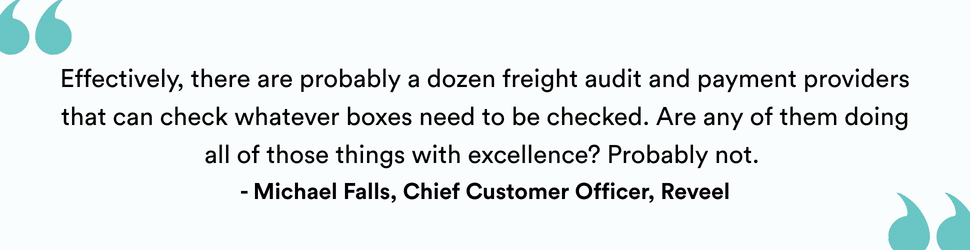
The core issue is that most traditional freight RFPs focus heavily on operational processes that were differentiators a decade ago but are now the norm for nearly every provider in the market. When sourcing teams lack deep logistics expertise, they compensate by asking broad questions to cover every possible requirement, which produces responses that are nearly impossible to differentiate.
Vendor declarations about technology capabilities end up sounding identical. Analytics and optimization tools get minimal scrutiny. And the providers best positioned to deliver real transportation intelligence get lost in a sea of checkbox responses.
The result: RFPs built around generic criteria inadvertently filter out modern technology platforms and funnel responses toward managed service providers instead. Instead, shippers should be testing for 7 key capabilities.
7 Capabilities Your Freight RFP Should Test For
A modern freight audit and payment RFP evaluation should reveal whether a vendor can deliver actionable transportation intelligence across all your modes, in real time. That means asking about:
1. Shipment-level transparency
Can your team access data directly, or does everything get filtered through a vendor’s analysts? Technology platforms surface this in dashboards you control. Managed services keep it behind their wall.
2. Managed services vs. technology platforms
Most providers call themselves “technology-enabled managed services,” which often means analysts running Excel or SQL Server behind the scenes. That model doesn’t scale. Real platforms put transportation data directly in front of the shipper.
3. Scenario modeling and simulation
Can you test different carrier pricing scenarios using your own shipment data, without waiting weeks for a consultant’s spreadsheet? SaaS platforms do this in minutes.
4. AI with substance
Require vendors to name specific models, provide accuracy metrics, and demonstrate client-facing tools. Audit decisions made by AI should be traceable and explainable, not a black box.
5. All-modes audit depth
“Multi-modal” means different things to different vendors. Parcel, LTL, FTL, Ocean, Air, Rail, and Intermodal each carry their own audit complexity. Require mode-by-mode detail, not a single checkbox.
6. Business model alignment
Per-invoice pricing escalates as your volume grows. SaaS subscription models decouple cost from volume, giving shippers more predictable spend.
7. Proof of concept
Ask vendors to demonstrate capabilities using sample shipment data during the RFP itself. What a provider can actually do with your data tells you more than any written response.
Download the Free Freight RFP Playbook
We partnered with Supply Chain Dive to put all of this into a practical guide: How to Run a Freight Audit & Pay RFP That Actually Delivers Savings.
The playbook covers why traditional freight RFPs attract the wrong vendors, how to tell a technology platform from a managed service, and what to actually test for during evaluation.