
Reveel's 2nd Annual Report · 240 Mid-to-Enterprise Shippers Surveyed
The State of Shipping 2026: Why the Shipping Operating Model Hasn't Kept Up
Now in its second year, Reveel’s annual benchmark tracks how mid-to-enterprise shipping operations are keeping pace with the market. This year’s independent survey of 240 logistics, supply chain, finance, procurement, and IT leaders, conducted by Incisiv on behalf of Reveel, found that most shippers have the technology to manage multi-carrier complexity but still run it on a quarterly or annual cadence, while carrier pricing and surcharges now change weekly.

Commissioned by Reveel. Independently conducted by Incisiv. Free to download.
What the research found, in brief:
- This is Reveel's 2nd annual State of Shipping report, tracking how shipping operations are keeping pace with the market year over year.
- 56% of shippers manage three or more parcel carriers, and 22% manage six or more.
- 67% face frequent or very frequent carrier rate and surcharge changes.
- 78% confine contract compliance review to a monthly or quarterly cycle.
- Only 13% benchmark carrier rates against the market outside the annual RFP cycle.
- 75% lack a cross-functional (logistics, procurement, finance) approach to shipping spend governance.
Methodology: 240 respondents across retail, apparel and footwear, life sciences, automotive, manufacturing, and 3PLs, surveyed independently by Incisiv on behalf of Reveel.
Why hasn't the shipping operating model kept up with the market?
Because most organizations built their shipping operating model for stability, quarterly reviews and annual rate negotiations, and that model hasn’t been re-paced for a market where carrier pricing and surcharges now shift weekly or more often.
Most shippers didn’t fail to invest. Three in four have standardized or automated how they select carriers. Most have consolidated spend onto a single platform and built the analytics to watch it.
The gap is cadence, not capability. Only 13% of shippers benchmark their rates against the market outside the annual RFP cycle. Nearly half rarely or periodically review surcharges and accessorial fees, even though two-thirds of the market faces frequent rate changes. That gap, between what organizations can see and how fast they act on it, is where margin quietly erodes.
What three forces are reshaping
shipping in 2026?
Accountability, pricing, and delivery expectations are shifting simultaneously, and each one on its own is straining shipping operating models built for a slower, more consolidated carrier environment.

Shift 1: Accountability.
Shipping decisions now cut across logistics, procurement, and finance, each optimizing for something different. 75% of organizations still lack a cross-functional approach to shipping spend governance.

Shift 2: Pricing.
Seasonal budgeting assumed a pricing stability that no longer exists. Mid-cycle adjustments, dimensional constraints, and localized surcharges shift continuously, and even small audit delays compound into real financial waste.

Shift 3: Expectation.
Cost is no longer the only scorecard. 46% of respondents name delivery timelines and service expectations a top source of shipping complexity.
What does the report actually measure?
The report benchmarks 240 organizations across four dimensions of shipping management, from cost visibility to cross-functional infrastructure, across six industry verticals.
Four dimensions:
- Technology & Integration — the infrastructure that moves intelligence across systems and functions.
- Decisioning Intelligence — the logic that selects carriers, routes, and responses as conditions change.
- Network & Spend Visibility — how deeply shippers see actual cost-to-serve before averages blur it.
- Contract & Billing Integrity — how carrier contracts are monitored and enforced at the point of execution.
Six industries benchmarked: retail, apparel and footwear, life sciences, automotive, manufacturing, and the 3PLs that serve them.
What do shippers say would create the
most value going forward?
Faster issue identification and greater cost predictability, ranked above delivery performance improvements, according to the surveyed leaders.
That’s a signal, not a footnote: the industry is shifting from reacting to shipping outcomes toward gaining real control over the decisions that drive them.
Where does your own shipping operation stand?
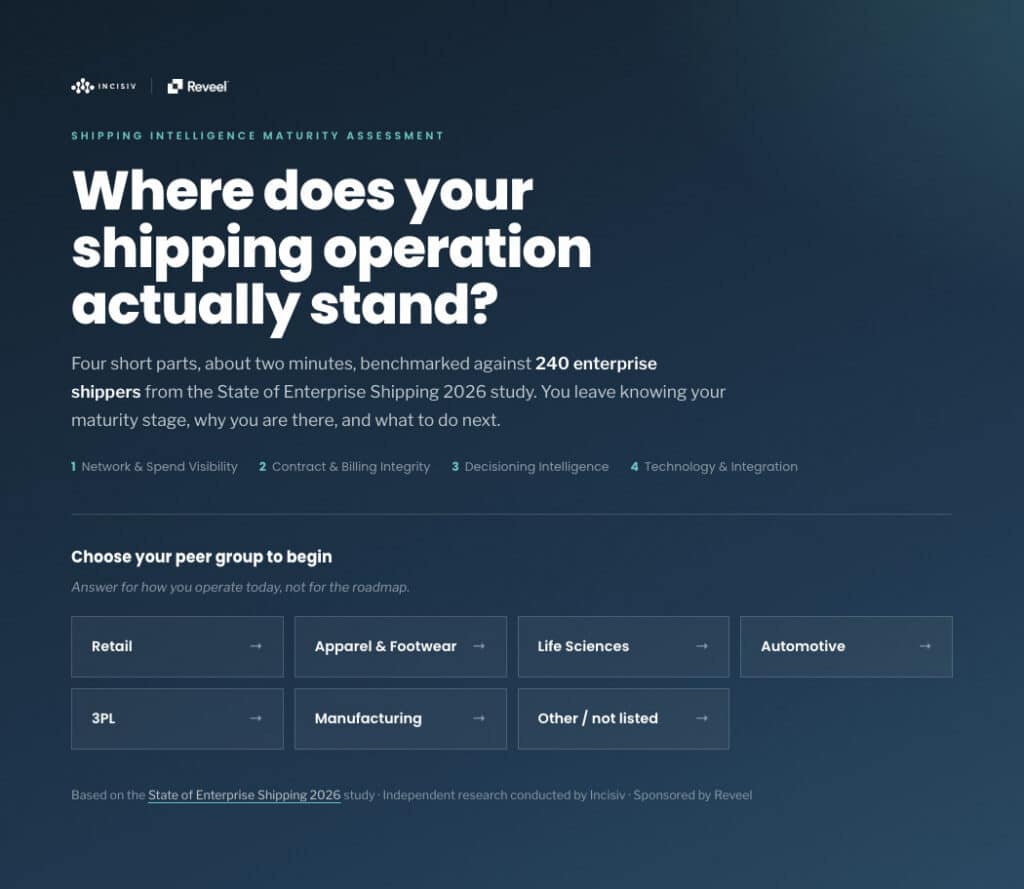
Alongside the report, Reveel offers a free Shipping Operating Model Maturity Assessment, a short, self-guided questionnaire that scores your own operation against the same four dimensions the report benchmarks, and shows how you compare to the 240 organizations surveyed.
The report tells you where the market stands. The maturity assessment tells you where you stand against it. Answer a short set of questions about your technology and integration, decisioning intelligence, contract and billing integrity, and network and spend visibility, and get a scored breakdown of your organization’s shipping operating model maturity relative to your peers and to your industry vertical.
"The struggle isn't that shippers failed to keep up on capability. They have. What hasn't caught up is the cadence. A capability you already own is far easier to put to work than one you have to build from nothing. The shippers who pull ahead won't be the ones with the most tools. They'll be the ones who close the distance between what they can see and how fast they act on it."

Jack McCrum
Director of Optimization and Analytics, Reveel
See Where Your Operation Stands
Download the full report for the complete benchmark data across all four dimensions, six industry breakdowns, and the operational shifts leading shippers are making to close the gap. Then take the free maturity assessment to see how your own shipping operating model compares.
FAQs
What is the State of Enterprise Shipping 2026 report?
It’s an independent research study of 240 enterprise logistics, supply chain, finance, procurement, and IT leaders, commissioned by Reveel and conducted by Incisiv, examining how well shipping operations have kept pace with a faster-moving carrier market.
Is this the first year Reveel has published this report?
No. This is Reveel’s 2nd annual State of Enterprise Shipping report, building on the inaugural edition to track how enterprise shipping operations are evolving year over year.
Who conducted the research?
Incisiv, an independent industry insights and strategy firm, surveyed the 240 respondents on Reveel’s behalf across six vertical markets.
How many parcel carriers does the average enterprise shipper manage?
56% of enterprise shippers manage three or more parcel carriers, and 22% manage six or more, according to the report.
How often do carrier rates and surcharges actually change?
67% of enterprise shippers report frequent or very frequent carrier rate and surcharge changes, but 78% still confine contract compliance review to a monthly or quarterly cycle.
Which industries are covered in the report?
Retail, apparel and footwear, life sciences, automotive, manufacturing, and the third-party logistics providers (3PLs) that serve them.
Is the report free?
Yes. The full report is available as a free download after completing a short form.
Is there a way to see how my own shipping operation compares to the report's findings?
Yes. Reveel’s free Shipping Operating Model Maturity Assessment is a short questionnaire that scores your operation against the same four dimensions covered in the report and shows how you compare to peers in your industry.