Carrier contract management software centralizes freight and parcel carrier agreements, monitors them for changes, and analyzes every invoice against the terms a shipper actually negotiated and agreed to.
Contract management has outgrown spreadsheets and inboxes. Carrier pricing no longer changes once a year with the general rate increase. Surcharges, mid-year base rate increases, and accessorial fees now increase costs throughout the year. Discounts expire without notice, revenue tiers slip, and the gap between negotiated terms and billed charges only surfaces when the invoice arrives. Advanced software closes that gap by continuously monitoring contracts, so shippers act on changes before they reach the invoice rather than after.
Key Takeaways
- Carrier contract management software centralizes freight and parcel agreements, monitors them for changes, and audits every invoice against negotiated terms.
- The features that enterprise shippers need to manage carrier contracts are automated invoice auditing, real-time monitoring, automated alerts for surcharges, and package-level data analytics.
- Carrier pricing now shifts throughout the year via mid-year rate increases and surcharge updates, so continuous monitoring protects margins more effectively than a single review at renewal.
- Strong platforms also model rate scenarios and track incentive tiers, turning package-level data into decisions that support ongoing carrier contract strategy.
What Is Carrier Contract Management Software?
Carrier contract management software analyzes carrier agreements, tracks their terms, and monitors performance against those terms over the life of the contract. It’s part of your carrier management strategy and applies to both parcel carriers, such as UPS and FedEx, and freight carriers across air, ocean, rail, LTL, and FTL. The purpose is to keep a signed agreement working as well on day 300 as it did on day one.
A carrier contract is a dense document filled with technical jargon that can be difficult for most shippers to understand. It contains items such as:
- Zone-based rates
- Accessorials and surcharges that apply per shipment
- Earned discounts
- Revenue tier thresholds
- Incentive terms and rebates that shift as shipping volume changes
- Early termination clauses
Managing this process manually means tracking hundreds of variables across every invoice, which is why most shippers only discover a problem long after they have already paid for it.
Carrier contract management is one part of a broader parcel spend management practice. Are you managing complex agreements? Learn more in the complete guide to carrier contract management.
Why Are Carrier Contracts So Hard to Manage?
Carrier contracts are hard to manage because their costs change constantly while the signed agreement sits still. A shipper locks in one set of terms, but carriers adjust pricing throughout the year, and every adjustment can pull the real cost of a shipment away from what was negotiated. The pace has outrun how most shippers operate. Reveel’s 2026 State of Enterprise Shipping research discovered that 86% of enterprise shippers make decisions without complete insight into actual conditions and only 12% can model the impact of a rate change before it takes effect.
The General Rate Increase used to be the one predictable event, a single annual change across base rates and surcharges. Not anymore. UPS and FedEx now layer in mid-year base rate increases, new and rising surcharges, and revised definitions of what triggers a fee.
Reveel’s research found that 67% of shippers now face frequent or constant changes to carrier rates and surcharges. Delivery area surcharges, for instance, are based on a destination’s population density, and both UPS and FedEx now apply them across suburban and urban ZIP codes, not only remote rural ones. A shipment that carried no such fee last year can carry one this year without notifying the shipper.
A carrier contract full of moving parts. Tracking every variable against every invoice with spreadsheets is where the process breaks down: discounts expire without notice, revenue tiers slip, and the shipper usually finds out only when a higher invoice lands.

7 Features to Look For in Carrier Contract Management Software
1. Complete Visibility Across Multiple Carrier Agreements
The first thing to look for is a single system that can hold and analyze agreements across multiple carriers. Strong platforms consolidate parcel and freight contracts in one place and surface the details buried within them, including discount structures, revenue-tier thresholds, and negotiated accessorial rates. When contract terms are linked to actual shipping data at the package level, a shipper can see what was agreed and how those terms play out in real shipments.
2. Automated Invoice Audit Against Contract Terms
Effective software compares every invoice, at the package level, against the negotiated agreement automatically and flags anything that does not match. Automated invoice audits catch:
- Billing errors
- Incorrect surcharges
- Duplicate charges
- Weight discrepancies
- Service failures eligible for refunds
3. Real-Time Monitoring and Automation
Look for a platform that monitors shipping activity continuously rather than in delayed monthly batches. The traditional model waited weeks for an audit report, by which point overcharges have already compounded across hundreds of shipments. Continuous monitoring flags discrepancies as they occur, and automation handles repetitive checks that are nearly impossible to perform by hand at scale.
4. Automated Alerts for Renewals, Surcharges, and Rate Changes
Carriers rarely notify shippers when a discount lapses or a revenue tier shifts, so the best contract management platforms notify shippers of changes before it reaches an invoice, not after. Look for a platform with alerts covering:
- Discount expirations
- Revenue tier movement
- GRI and mid-year surcharge changes
- Contract renewal windows
5. Cost Modeling and Scenario Simulation
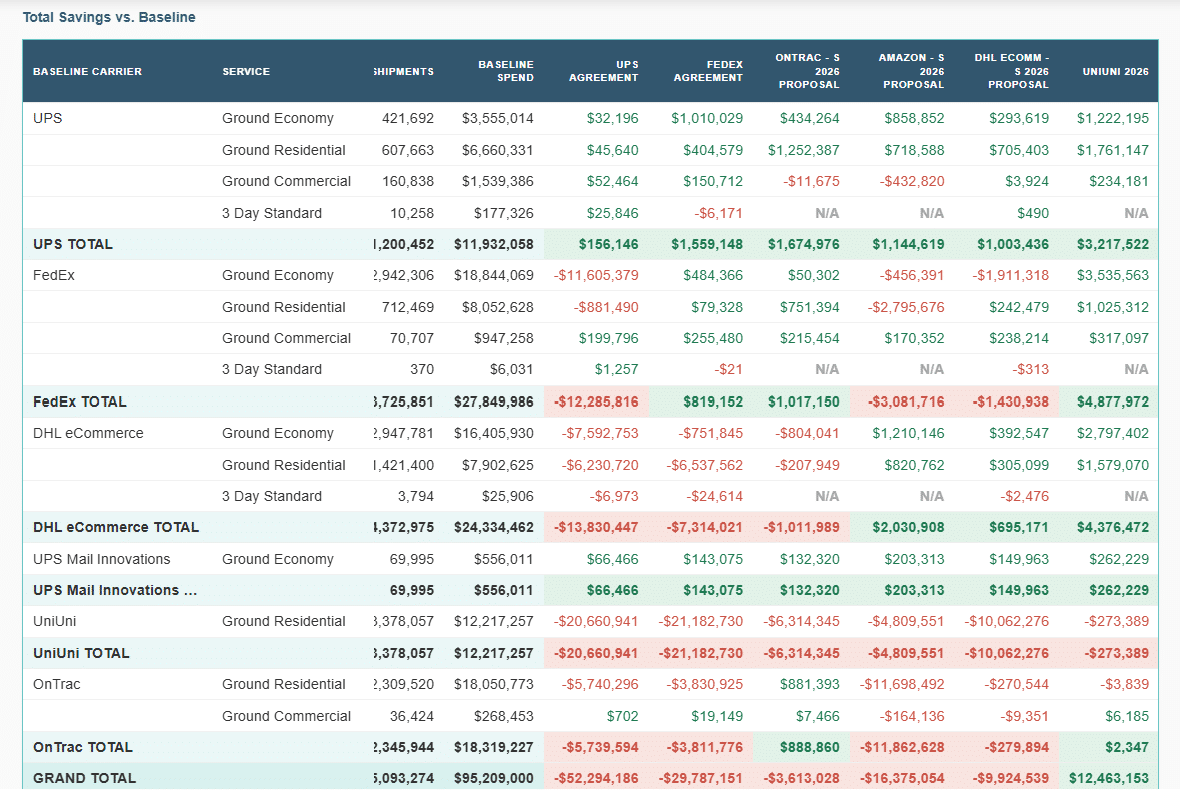
Strong contract management software models the true cost of shipping every package by applying the full contract, including every discount, accessorial, and surcharge, to a shipper’s actual shipping data. Headline base rates rarely reflect the actual cost of a shipment once surcharges and additional fees are added, so accurate package-level modeling shows the real cost per shipment, service level, and zone.
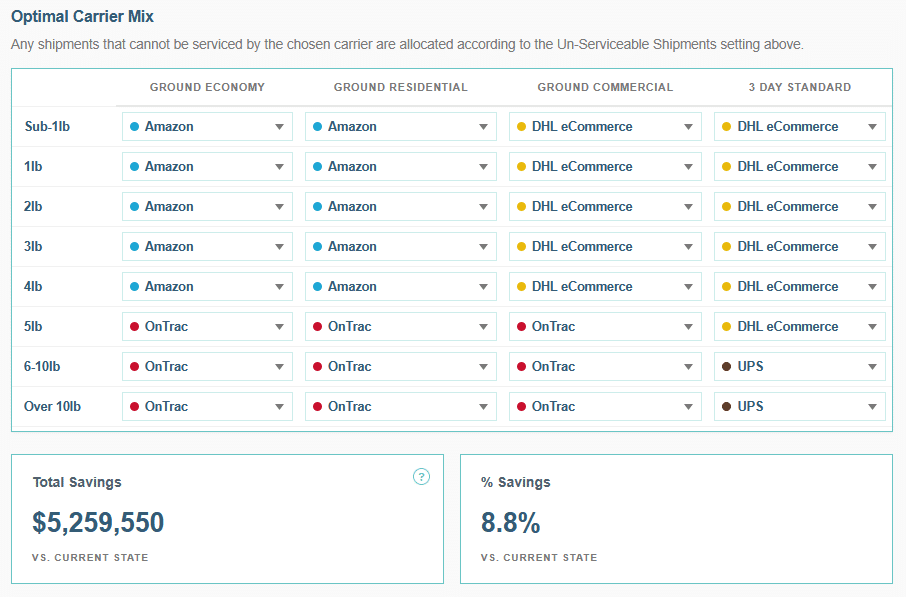
The same engine should also test changes before a shipper commits to them, answering questions that a static contract cannot, such as how a proposed GRI would apply to a specific shipping profile or what happens to costs when volume shifts from one carrier to another. Modeling shows what shipments cost today; simulation shows what they would cost under different terms.
6. Volume and Incentive Optimization
Beyond flagging changes, strong software helps shippers use their volume as leverage. Earned discounts and revenue tiers are built around volume thresholds, and the right platform shows how much a shipper can move to another carrier without slipping below a tier and losing the associated discount. That visibility turns volume allocation into an active decision rather than an accident of routing, and it gives shippers concrete footing for contract discussions with their carriers at renewal.
7. Performance Analytics Built on Package-Level Data
The average carrier agreement software relies on account-level estimation, but with more shippers moving to multi-carrier strategies, shippers need to be able to go a step further with their data. Look for software like Reveel that has package-level precision across major carriers, regional partners, and alternative networks.
Package-level data surfaces the patterns that drive cost:
- Cost per package by service type and destination zone
- Surcharge and accessorial spend trends
- Carrier performance against service commitments
- Volume and weight patterns, including dimensional weight
How Should Shippers Evaluate a Carrier Contract Management Platform?
The market is filled with general contract lifecycle tools, freight audit and payment providers, parcel spend management platforms, and traditional consultants, each suited to a different need. Before committing, shippers should weigh a handful of factors:
- Data granularity, meaning whether the platform works from package-level data or account-level summaries
- Mode coverage, or whether it handles both parcel and freight or only one
- Integration with existing ERP, warehouse, and order management systems
- Transparency of outputs, so results can be understood and acted on rather than taken on faith
- Ongoing support for continuous carrier contract strategy, not just a point-in-time review
The right platform depends on the complexity of the shipping operation it serves. An enterprise shipper moving thousands of packages a day across several carriers needs continuous monitoring and package-level analytics, while a lighter operation may be well served by a simpler tool.
Reveel Brings Every Feature Into One Platform
Each of these seven features protects margin on its own. Together, they turn a signed contract into an agreement that keeps working for its full term. Reveel’s Shipping Intelligence Platform has carrier agreement management that monitors contracts continuously, enables shippers to drill down into package-level data, and uses cost modeling and simulation to reveal the real impact of a rate change before it reaches an invoice.
Request a demo with our team today!
Frequently Asked Questions
What is the difference between carrier contract management and parcel audit?
Carrier contract management covers the entire agreement: monitoring terms, tracking discounts and revenue tiers, and modeling costs over the life of the contract. Parcel audit is one function within that scope: the process of checking individual invoices against tracking data and negotiated rates to catch billing errors and recover refunds. Contract management is the strategy; parcel audit is one of the tools that supports it.
Can carrier contract management software track surcharges and GRI changes?
Yes. Advanced platforms like Reveel continuously monitor surcharge changes and GRIs, then model how each affects a specific shipping profile rather than applying a carrier’s published average.
What is the best technology for ongoing parcel contract optimization, not just one-time negotiations?
The best technology for ongoing optimization monitors agreements continuously rather than reviewing them once at renewal. Reveel’s carrier contract management solution tracks discount expirations, revenue tier status, and surcharge changes in real time, and alerts shippers before a cost change lands. This keeps a contract optimized across its full term, turning contract management into a continuous practice instead of a periodic event.
Is there a shipping analytics platform that can show where I am overspending with UPS and FedEx?
Yes. Reveel’s shipping intelligence platform uses package-level data to pinpoint where spend is leaking across all carrier shipments, breaking down costs by service type, zone, surcharge, and accessorial.
Which platforms can predict the cost impact of a carrier’s general rate increase?
Reveel’s contract management solution predicts the cost impact of a General Rate Increase by applying the new rates and rules to a shipper’s actual historical shipments. This shows the real increase by service type instead of the carrier’s announced average, which rarely matches what any individual shipper will pay, and points to the terms worth revisiting before the increase takes effect.